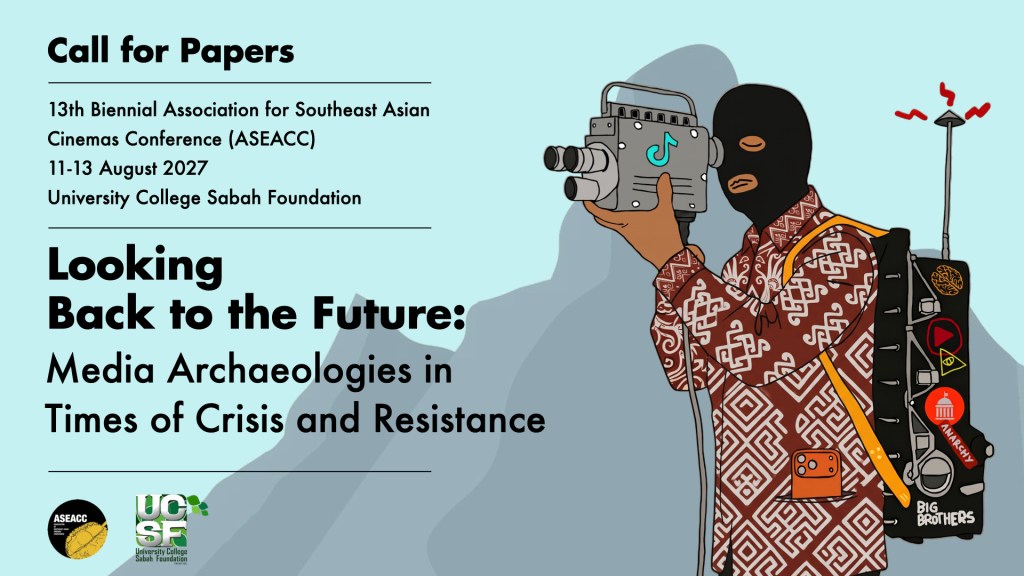
Looking Back to the Future: Media Archaeologies in Times of Crisis and Resistance
11 – 13 August 2027,
University College Sabah Foundation
Jalan Sanzac, 88100 Sembulan, Kota Kinabalu, Sabah
Since the early 2000s, media production and distribution in Southeast Asia have undergone substantial democratisation, led on by the availability of new technologies like digital video and platforms like YouTube, while the weakening grip of traditional studio systems and changing financing needs and patterns of co-production helped open cinema to a whole generation of filmmakers. Even as these opportunities ensued, the last twenty years have also ironically witnessed multiple interconnected crises that challenged these possibilities of media democratisation. AI is at the center of the current “polycrisis” in which geopolitical, social, economic and environmental catastrophes overlap. Seen by some as a beacon of emancipatory possibility, for others the ubiquity of AI across various media platforms and technologies (and now being adopted for military and state surveillance) risks losing the very thing that makes us human.
Responding to these concerns, the 2027 Association for Southeast Asian Cinemas conference invites individual papers or organised panels that take a media archaeological approach: examining how past media production and distribution practices are also entangled with the present and the future. For instance, digging into older “revolutions” (and their aftermaths) when formats, paradigms, styles and technologies shifted radically as a way to understand what is happening around us now and what is to come.
Papers may consider the following questions: What can media archaeology reveal about the connections between creative practice and technology during periods of social upheaval and unrest? How can we use media archaeology (and modern technology, potentially including AI) to find and define new archives of old materials? What is the role of the archive — both within and outside of institutional contexts — in preserving these images and sounds, of crisis and resistance, for future viewers and makers? What can older forms of technology such as Super 8mm, 16mm or video formats like Portapaks or home video (VHS, betamax, 8mm, miniDV, etc) reveal about moments of resistance in earlier times of crisis? How have film and video aesthetics (including more recent audiovisual forms) offered counter-narratives that provide alternative perspectives on the past, present and future? How have narratives of earlier films been adapted for contemporary audiences? How do diasporic Southeast Asian filmmakers negotiate their positionalities to imagine different pasts of their homelands? In what ways have film and video cultures shaped critical responses to political and social upheaval and how have film and video communities worked together to reimagine what is possible?
- Possible topics include but are not limited to:
- Archival practices in and outside of institutional contexts
- Community media and video activism
- VHS & home taping
- Television and memory
- Video Art
- Found footage
- Film and video collectives and communities
- Home movies
- Diasporic Southeast Asian cinema and nostalgia
- Experimental cinema
- Past waves of independent cinema and short films
- Music videos and changing technologies
- Youtubers who bring together past and present forms and styles of cinema and video making
Abstract Submission Deadline: January 1, 2027
Panel and Paper Proposals
Panels should have at least three papers but not more than four papers. The panel organizer must submit the entire package, which includes: the panel title, the overall panel abstract, the individual abstracts for each panel presenter, and presenter bios (which must include the email and affiliation for each presenter).
Please use the online forms below to submit your paper proposals. This form is for standalone individual papers only. Do not use this form if your paper is part of a proposed panel. Paper abstracts should not exceed 300 words.
Graduate Students’ Workshop
Following the inaugural Graduate Students’ Workshop at the 2025 ASEACC in Chiang Mai, we are also pleased to announce that a second workshop will be held on August 10, 2027, in conjunction with the 2027 conference. Workshop participants will be divided into small groups, with each group working with a mentor. Mentors and participants will read each other’s work and exchange feedback and ideas to help prepare a completed work for publication or develop works-in-progress. Possible works include future conference presentations, research publications, dissertation/thesis chapters, and papers written for previous coursework.
For the upcoming workshop, graduate students are invited to apply to attend by filling in the form and including an abstract of the paper they wish to feature at the workshop. The paper can be of any topic as long as it is related to Southeast Asian cinema and screen. The abstract must not exceed 300 words.
For conference inquiries, please email the abstracts committee: Alicia Izharuddin (National University of Singapore, [email protected]); Emerald F. Manlapaz (University of the Philippines-Diliman, [email protected]); Laurence Marvin S. Castillo (University of the Philippines- Los Baños, [email protected]); Sophia Siddique Harvey (Vassar College, [email protected])

